




- Published on: 2026-11-07 18:32:23
How to Scale from Micro Lots to Mini Lots by Account Risk
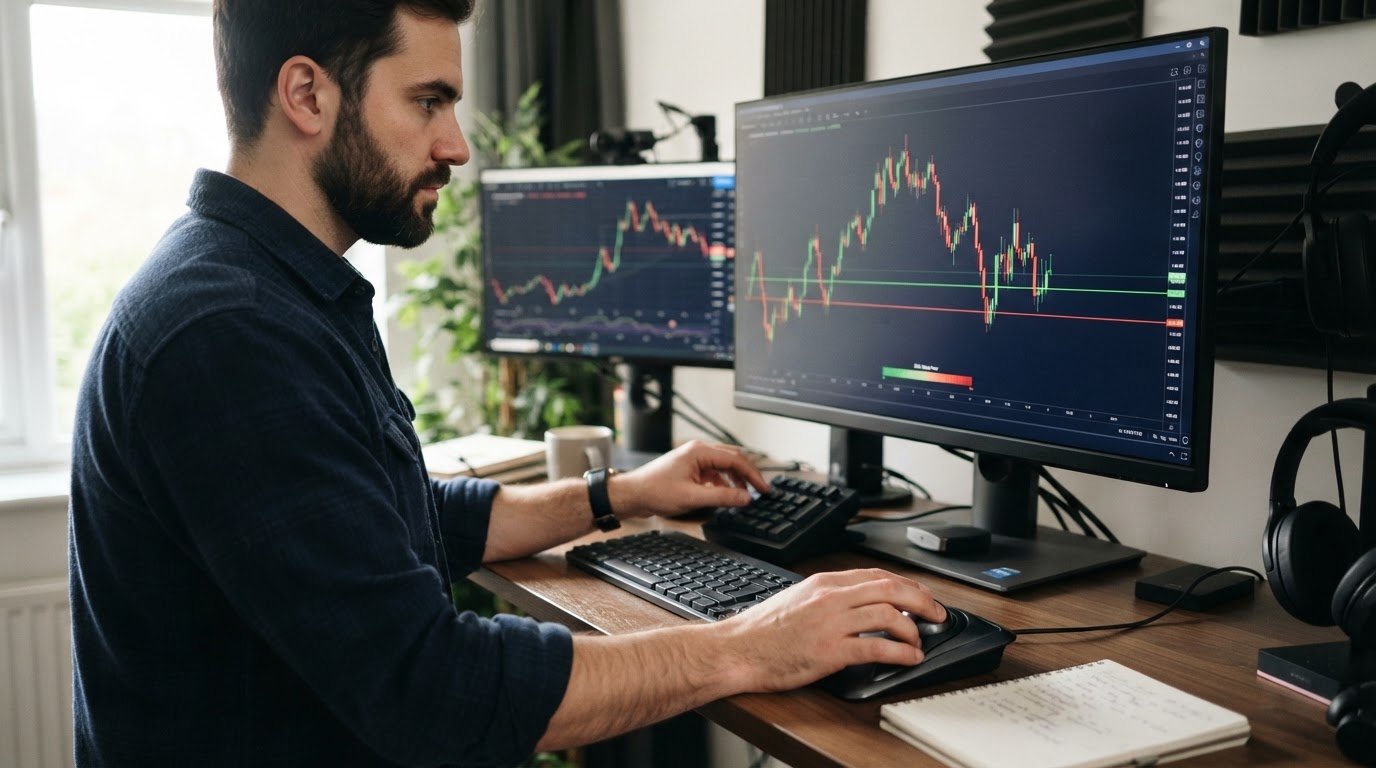
A jump from a micro lot to a mini lot is bigger than it looks. Scaling from micro lots to mini lots safely means sizing each trade around your account risk and stop-loss distance, not simply switching from 0.01 to 0.10 lots. That change multiplies position size by 10, so a gradual path such as 0.01, 0.02, then 0.03 lots gives you room to assess the added exposure.
It’s natural to consider a larger position as your account grows, but lot size alone doesn’t determine how much a trade can lose. Your risk depends on how much you’re willing to lose and the distance between your entry and stop. Set those inputs first, then calculate a position size that fits.
This guide explains how to set a risk limit, calculate micro-lot size, and use a position-size calculator and trading journal to track your decisions. You’ll also learn how to increase size in measured steps as your trading allocation grows, while keeping your stop-loss plan and discipline intact.
Key Takeaways
- Use your account’s risk limit and stop-loss distance to determine a position size that fits each trade.
- After an allocation increase, step up gradually and use your trading record to guide the next adjustment.
- Use a position-size calculator to check the numbers, then journal trades to spot patterns in your execution and risk.
- Account for leverage and margin as well as potential losses; a position that fits your risk plan still needs sufficient margin.
- Build confidence with smaller positions before progressing to larger lot sizes.
Gradually increasing position size after an allocation bump
- Recalculate your risk using the new allocation before changing position size. Treat an allocation increase as added capacity, not permission to multiply every trade. For example, a 25% larger allocation doesn’t automatically justify a 25% larger position. One gradual approach starts by increasing size by about 10-12%, then trading for a week before considering another adjustment.
- Keep your risk rule steady while you test the change. A suggested approach is risking 0.5-1% per trade while qualifying for an allocation increase. If your risk limit changes, recalculate each position using its stop distance. A larger allocation can support a larger position, but the potential loss also grows when contract size rises.
- Change one variable at a time. Keep the strategy, entry rules, and stop-loss method consistent while testing a new position size. A move from 0.01 lots to 0.10 lots is a 10-fold increase, not a routine adjustment. Instead, record the new size separately and review whether your execution remains disciplined through both wins and losses.
- Validate the strategy before stepping up. For a new strategy, one suggested test is 20-30 live trades at 0.01 lot before moving toward normal size. An Expert Advisor example uses 30 live trades at one micro lot per trade before scaling. Review at least 50 trades when assessing consistent profitability, rather than treating one strong moment as proof.
- Use your journal to assess the psychological impact of a larger position. Before increasing size, consider whether three consecutive losses would undermine your discipline. Note whether greater exposure leads you to exit early, move stops, or take trades outside your plan. If it does, return to your previous size and rebuild consistency before testing another increase.
- Keep trading scale-up separate from production decisions. A business may assess product-market fit through consistent sales and repeat customers before expanding production. That milestone doesn’t determine forex position size, which depends on your allocation, risk per trade, stop distance, and execution. Keep these decisions in their proper context rather than applying a production target to a trading account.
- Keep reactor scale-up separate, too. In continuous-flow microreactor work, scale-up can involve numbering up, sizing up, or combining both; increasing reactor length is a process-design decision, not a lot-sizing method. For trading, define your next position-size step in advance and review the results before proceeding. Scaling from micro lots to mini lots safely means following a controlled process, not reacting to one profitable trade.
Calculating micro-lot size from account risk
For U.S. forex trading, broker rules on leverage, margin, and minimum trade size affect the collateral required and the smallest position you can place. They don’t replace risk sizing. Calculate exposure from your stop loss and risk limit, then make sure the resulting position meets the platform’s trading requirements.
-
Set Percentage-Based Risk Limits
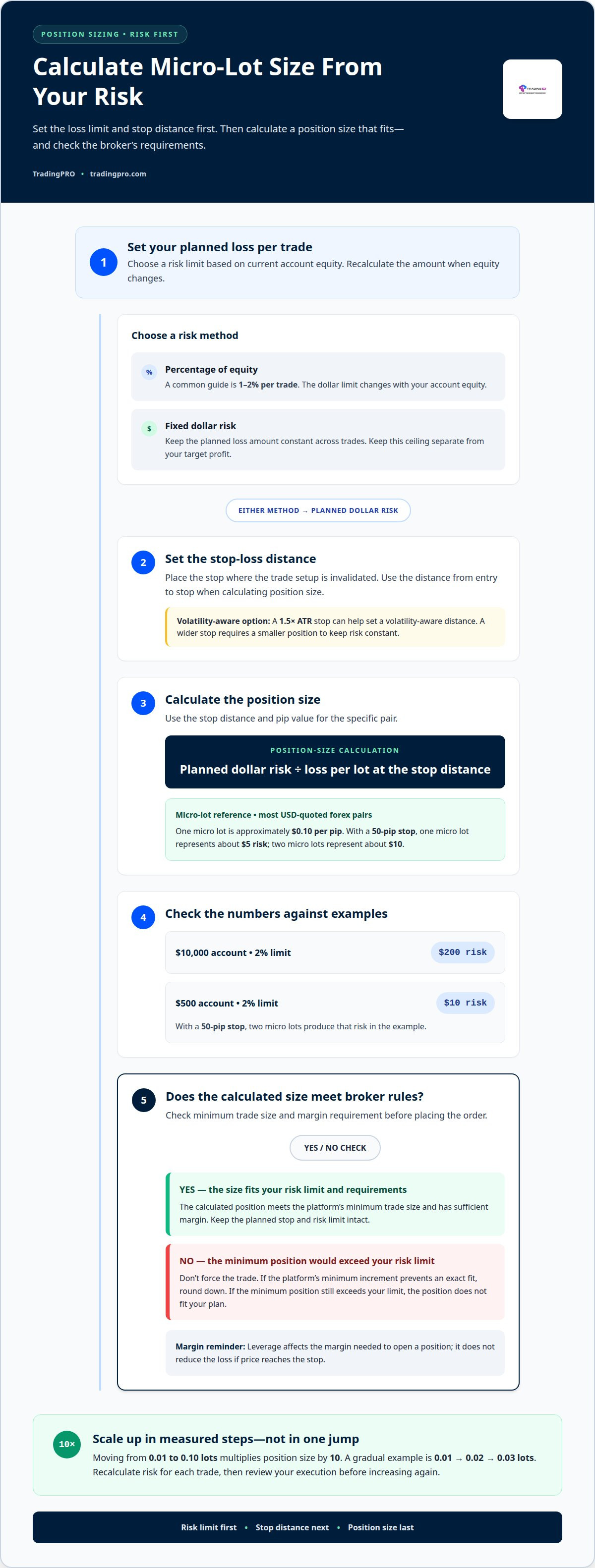
Set a percentage of your current account equity as the maximum planned loss for one trade. A common guide is 1-2% per trade, but choose a level that fits your risk management plan and can withstand a run of losses. Recalculate the amount when equity changes; a fixed percentage adjusts the dollar limit with the account.
Use small-batch thinking: limit initial exposure, review results, then adjust instead of committing more capital at once. In production, early batches of 50-100 units can help test demand; in trading, the equivalent is keeping position size controlled while you assess execution. Don’t treat a profitable trade as proof that a larger size is appropriate.
-
Choose Fixed Dollar Risk per Trade
Choose a fixed dollar risk when you want the planned loss to stay constant across trades. For a $10,000 account, a 2% limit equals $200 per trade. For a $500 account, a 2% limit equals $10; with a 50-pip stop, two micro lots produce that risk in the example.
Keep that dollar ceiling separate from your target profit. A risk-reward ratio of 1:2 means the planned reward is twice the amount at risk; 1:3 means three times the risk. These ratios don’t guarantee a result. First place the stop loss where the trade setup is invalidated, then calculate lot size to fit the dollar limit.
-
Calculate Micro-Lot Size and Consider Broker Rules
Calculate position size by dividing your planned dollar risk by the loss per lot at the stop distance. For most USD-quoted forex pairs, one micro lot is approximately $0.10 per pip. A 50-pip stop on one micro lot therefore represents about $5 of risk; two micro lots represent about $10.
Use the stop distance and pip value for the specific pair, then round down if the platform’s minimum trade increment prevents an exact fit. A 1.5× ATR stop can help set a volatility-aware distance, but wider stops require smaller positions to hold risk constant. Leverage affects the margin needed to open a position; it doesn’t reduce the loss if price reaches the stop.
Before placing the order, compare the calculated size with the broker’s minimum trade size and margin requirement. If the minimum position would exceed your risk limit, don’t force the trade. A TradingPRO trading account can be a next step for applying your risk plan on a trading platform.
Position-size calculators and trading journals
Pair a position-size calculator with a trading journal to make the risk of each setup measurable. Use the calculator before entering a trade, then record the result and how you executed it.
-
Validate Live Trades Before Scaling
Log each live trade with its instrument, entry, stop, position size, planned risk, and result. Review at least 50 trades before deciding whether a strategy has been consistently profitable. Separate rule-following trades from mistakes, so a winning result doesn’t conceal poor execution or an oversized position.
Use your journal to review results at your current size before increasing it. Record whether spreads or slippage affected the outcome, and note conditions such as volatility. A calculator estimates planned exposure, but only live records show how your method performs in actual trading conditions. Increase size after consistently following your rules, not after one favorable trade.
-
Set Risk Limits and Size from Stop-Loss Positions
Before placing an order, enter your account equity, chosen risk amount, instrument, and stop-loss distance into the calculator. The resulting lot size should keep your planned loss within your limit if price reaches the stop. If the stop moves farther away, recalculate. Keeping the original size would increase exposure beyond your plan.
Check the output against your journal after each trade. For most USD-quoted forex pairs, one micro lot is approximately $0.10 per pip: a 10-pip move changes profit or loss by about $1, while a 50-pip move changes it by about $5. These values help you spot an input error before trading. Account for spread costs, since spreads can take a larger share of small targets.
-
Track Pip Values, Exposure, and Margin
Record pip value and total exposure for every open position, especially when trading different instruments. On XAUUSD, a $1 gold-price move changes profit or loss by $10 on a mini lot; on a standard lot, the change is $100. A calculator should use the instrument’s contract details, not a forex pip assumption.
Compare margin used with available account capital before increasing size. Leverage can reduce the funds tied up as margin, but it doesn’t shrink the market exposure or the loss from an adverse move. For futures, plan exits before entry: one common approach reduces a position by one-third at regular intervals, and scaling out effectively requires at least 3 contracts. Record each exit separately to see how the plan affects results.
Gradual progression from micro to mini and standard lots
- Start at 0.01 lots and increase in controlled increments. A practical sequence is 0.01, 0.02, then 0.03 lots, rather than jumping straight to 0.10. In forex, a micro lot represents 1,000 units of the base currency, while a mini lot represents 10,000 units. Treat each step as a new position size to evaluate, not as an automatic reward for recent profit.
- Set a clear milestone before raising your baseline. For example, a 20% increase in account equity can prompt a review of your usual lot size. It isn’t a command to increase size by the same percentage. Recalculate risk using the current equity and stop distance, then decide whether a small adjustment still fits your plan. This keeps position sizing connected to capital, rather than to a winning streak.
- Keep your strategy steady while testing each increase. If your entries, exits, or stop placement change at the same time as your position size, you won’t know which change affected the result. Record trades at the new size and compare your execution with earlier journal entries. Consistently following the same rules matters more than a short run of profits. Return to your previous size if losses lead you to abandon your plan.
- Review the full exposure before moving from mini to standard lots. A standard forex lot represents 100,000 units of the base currency, compared with 10,000 units for a mini lot. That is a tenfold difference in unit exposure. Calculate the planned loss at your stop before placing the larger position, and avoid treating the standard size as the inevitable next step. Your account risk, not the lot label, determines whether the trade fits.
- Advance only when your records support the next step. Compare planned risk with actual outcomes, note whether spread or volatility changed execution, and check that losing trades didn’t trigger revenge entries. Moving from 0.01 to 0.10 lots is a 10-fold increase, so test intermediate sizes rather than scaling in one jump. Scaling from micro lots to mini lots safely means preserving your strategy and risk limits as exposure grows.
Leverage and Margin Risks: Micro to Mini Lots
- Separate margin from trade risk before increasing size. Margin is the funds set aside to open and maintain a leveraged position; risk is the potential loss if the price moves against you. Leverage lets a position control more market exposure than the margin committed, but it doesn’t reduce that exposure. Calculate your stop-loss risk first, then review the platform’s margin figure before placing the order.
A trade can fit within your available margin and still exceed your planned loss if the position size is too large. Treat margin and risk as separate checks.
- Compare the required margin for your current position with that for the proposed larger one. Increasing lot size increases market exposure and generally requires more margin under the same trading conditions. Check the order preview for margin used and remaining free margin, and consider how open trades draw on that balance.
A position that uses most of your available margin leaves less room for adverse price movements and other open positions. Don’t treat the platform’s maximum permitted size as your personal risk limit.
- Stress-test the position against a realistic stop and price move. For XAUUSD, a $1 gold-price move changes profit or loss by $10 on a mini lot. A $10 adverse move on a 0.10-lot position therefore represents a $100 loss in the example. Calculate the same exposure for your intended instrument before increasing contract size.
Price can move toward your stop during volatile conditions while margin remains committed. Include the full planned position, stop distance, and existing trades in your calculation rather than assessing a new order on its own.
- Set a margin buffer as part of your trade plan. Before entry, record the required margin, free margin after entry, stop level, and total account risk. If a new position would use funds needed to maintain existing trades, reduce its size or skip the setup. This can help you avoid overlooking concentration across several correlated trades when one position is profitable.
Review the numbers whenever you add an order or move a stop. Adjusting a stop changes planned loss, while adding exposure can change both margin use and total account risk.
- Use a micro position to learn how your platform displays margin and floating profit or loss before moving to a mini size. Record the difference between planned and actual exposure, including the effect of the spread, then repeat the calculation at the larger size. Keep the same stop logic; don’t widen a stop just to accommodate a larger position.
Ready to put a measured trading plan into action? Open a TradingPRO account and apply your position and margin checks before each order.
TradingPRO: Micro Account
TradingPRO’s Micro Account is an option for applying your position-sizing process with smaller trade sizes. Use your risk calculation, stop-loss plan, and journal to guide each decision. An account type doesn’t replace those controls or determine the right lot size for you.
As your approach develops, choose an account tier that fits your trading needs, whether you continue with a Micro Account or consider another option. Base the decision on your strategy and risk management, not pressure to increase exposure quickly.
Contact TradingPRO to discuss the Micro Account and decide on your next step.
Make your next size decision deliberate
Treat your next trade as an opportunity to apply the same disciplined process, not a reason to rush into greater exposure. Scaling from micro lots to mini lots safely takes a series of decisions guided by your account risk, strategy, and ability to follow your rules under pressure. Keep your journal up to date as your position size changes, and let consistent execution guide your next move.
TradingPRO offers Rookie, Micro, and Pro Accounts to suit different trading needs. Choose the option that fits your approach, and keep your risk plan at the center of every decision.
Explore your next step with TradingPRO and move forward with focus and confidence.
Frequently Asked Questions
How Should You Use Micro Lots as a Beginner?
Use micro lots to practice following a written trading plan with limited position exposure. Before each order, record the setup, entry, stop, and reason for taking the trade. After closing, note whether you followed your rules. For example, if a stop is triggered, review whether it was placed where your trade idea failed rather than widening it to avoid recording a loss. Increase size only when your records show consistent execution.
How does position scaling work?
Position scaling means changing exposure in planned stages rather than making one abrupt jump. Scaling in adds to an open position, while increasing the size of later trades changes your usual position size. Scaling out reduces an open position as a trade develops. Decide which method you mean before acting: adding exposure increases potential loss, while reducing exposure lowers the amount that remains open.
The compounding maths of scaling: how long does it actually take?
It depends on how often your allocation grows and how large each increase is. In an illustrative calculation, a $50,000 allocation that rises by 25% at each four-month review reaches $122,070 after four cycles, or 16 months. The calculation compounds each increase on the new allocation. It describes that specific growth path, not a timetable for increasing lot size; trade size still needs its own risk calculation.
What Is Micro Lot Trading?
Micro lot trading means placing forex trades in small contract units, commonly useful when practicing with lower exposure. A micro lot represents 1,000 units of the base currency in a forex pair. On MT4 and MT5, that size is expressed as 0.01 lots. The platform’s displayed lot amount refers to the trade’s contract size, while your potential loss also depends on price movement and the stop distance.
What are micro lots and mini lots in forex trading, and how do their contract sizes compare?
A micro lot represents 1,000 units of a forex pair’s base currency; a mini lot represents 10,000 units. A standard lot represents 100,000 units. So a mini lot has ten times the base-currency exposure of a micro lot. For example, on GBP/USD, the base currency is the pound, so those units refer to pounds rather than the quote currency, U.S. dollars.
How much is a pip worth for micro lots versus mini lots in major currency pairs?
For most USD-quoted forex pairs, one micro lot is worth approximately $0.10 per pip, so a mini lot is approximately $1 per pip because it has ten times the units. The quote currency and exchange rate can affect pip value for other pairs. Check the instrument’s displayed pip value before trading, especially when the account currency differs from the pair’s quote currency.
How do you calculate position size based on account balance, risk percentage, stop-loss distance, and lot size?
Multiply your account balance by your risk percentage to find your planned cash risk. Then divide that amount by the loss per lot at your stop distance. A wider stop means fewer lots fit the same risk limit; a tighter stop allows more, if the trade setup supports it. Convert the result to the platform’s lot increment, rounding down if needed to stay within your risk limit.
What percentage of trading capital should a beginner risk per trade when scaling up lot size?
A commonly used guide is to risk 1-2% of account equity per trade, but the percentage alone doesn’t determine safe size. A beginner should account for the stop distance, open positions, and the effect of consecutive losses on decision-making. If increasing size makes it harder to follow the plan, return to a smaller position. Keep the chosen risk percentage consistent while evaluating whether execution remains disciplined.


