




- Published on: 2026-11-08 09:01:17
Choose Between Micro and Standard Accounts for Your Goals

A standard account isn’t automatically the next step for every trader. Choosing between a micro and standard account means balancing the exposure you want with the flexibility your strategy needs.
Start by comparing position size: smaller positions can make exposure easier to manage, while larger positions amplify both gains and losses. In futures, micro contracts are typically one-tenth the size of their standard counterparts, so each market move has a proportionally smaller dollar impact per contract.
Size is only one consideration. Compare costs, liquidity, spreads, and slippage, then weigh your goals, experience, and comfort with market swings. This guide explains how each option can fit different trading needs and offers a practical way to choose an account that matches your strategy.
Key Takeaways
- Match account size to your financial goal and the level of market exposure you can manage.
- Assess liquidity, bid-ask spreads, and slippage together; execution conditions can shape the outcome of a trade.
- Compare commissions and exchange pass-through fees across your expected trading activity, not in isolation.
- Use a micro account to test how your strategy performs in live conditions before considering larger positions.
- Move to a standard account when your approach is consistent and your account can absorb wider swings.
Liquidity, bid-ask spreads, and slippage
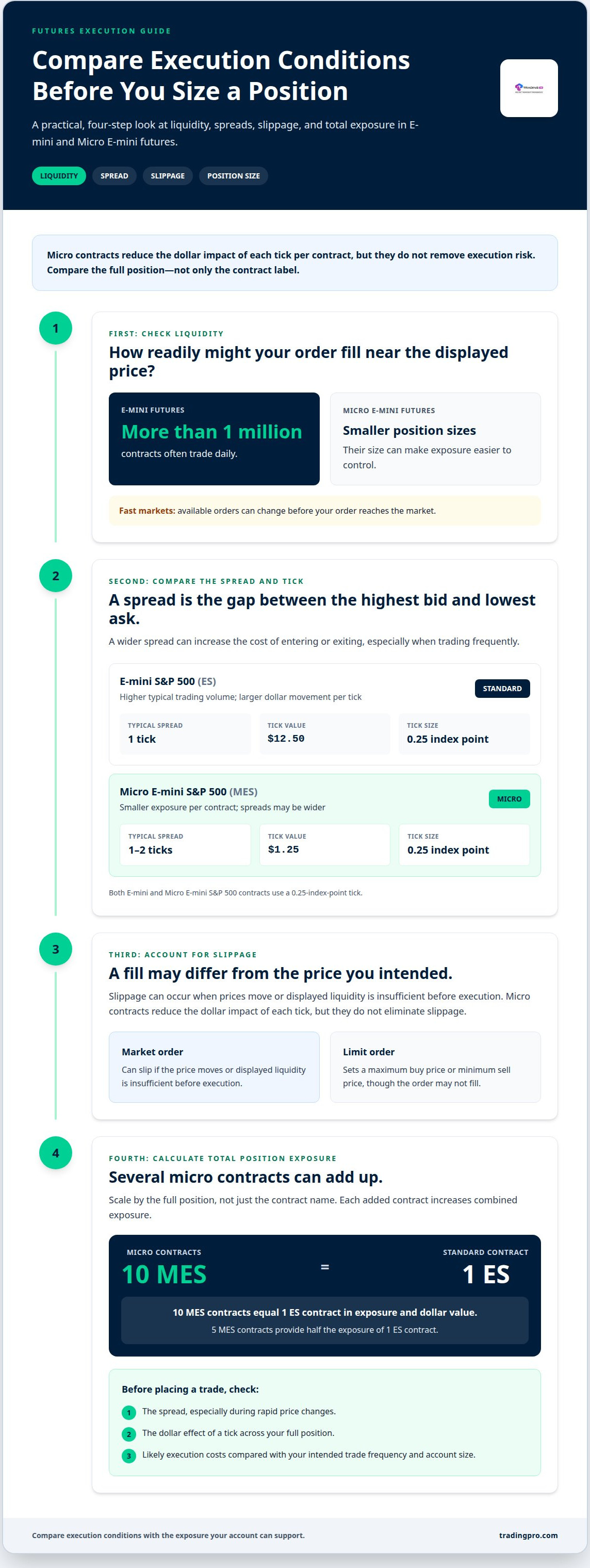
Liquidity affects how readily a futures order can be filled near its displayed price. E-mini futures often trade more than 1 million contracts daily, while Micro E-mini contracts offer smaller position sizes. This difference matters during fast markets, when available orders can change before yours reaches the market.
The bid-ask spread is the gap between the highest available bid and lowest available ask. A typical E-mini spread is one tick, while Micro E-mini futures commonly show one to two ticks. Both E-mini and Micro E-mini S&P 500 contracts use a 0.25-index-point tick. A wider spread can increase the cost of entering or exiting, especially for frequent futures trading.
Slippage occurs when an order fills at a different price than intended. A market order can slip if prices move or displayed liquidity is insufficient before execution. Smaller micro contracts reduce the dollar impact of each tick, but they don’t eliminate slippage. A limit order sets a maximum buy price or minimum sell price, though it may not fill.
Micro contracts can make exposure easier to control, but several micro positions can add up.
| Option | Typical spread | Tick value | Liquidity and exposure |
|---|---|---|---|
| E-mini S&P 500 (ES) | One tick | $12.50 per tick | Higher typical trading volume; larger dollar movement per tick |
| Micro E-mini S&P 500 (MES) | One to two ticks | $1.25 per tick | Smaller exposure per contract; spreads may be wider |
Use the table to compare execution conditions with the exposure your equity can support, choosing a setup that matches your intended position size, rather than contract size alone.
When scaling, consider the total position, not just the contract label. Ten MES contracts equal one ES contract in exposure and dollar value. Five MES contracts provide half the exposure of one ES contract. This flexibility can help you adjust entries or exits in smaller steps, but each added contract increases combined exposure.
- Check the spread before placing an order, especially during rapid price changes.
- Estimate the dollar effect of a tick across your full position.
- Compare likely execution costs with your intended trade frequency and account size.
When choosing between a micro and standard account, TradingPRO recommends prioritizing predictable exposure and workable execution. A standard contract may suit a strategy that needs larger position increments, while micro contracts offer more control over scaling. Both remain exposed to market movements, spreads, and slippage.
Choosing accounts for different financial goals
Start with your desired outcome, then match contract size and margin to the risk your account can carry. Micro and standard contracts can track the same market, but each position affects your exposure differently.
Lot and Contract Sizes
In futures, micro contracts are typically one-tenth the size of standard counterparts. Their smaller size lets you adjust exposure in finer steps, while each standard contract creates a larger position. Futures measure value through points and ticks, not a universal pip value.
Use the instrument’s point or tick value to calculate position risk. “Pip value” isn’t a consistent futures measure.
Leverage and Margin Requirements
Margin is the funds required to hold a futures position; leverage describes the exposure those funds control. A lower margin requirement corresponds to smaller contract exposure, not lower market risk per point for the same total exposure.
Choose position size based on the loss a planned market move could create, not the maximum position margin allows. A lower margin requirement can leave more capital available, but it doesn’t reduce the risk of adding contracts or holding through a sharp move.
Account Fit for Balance and Strategy
Traders with less than $10,000 often find Micro contracts a better fit, though balance alone doesn’t determine account choice. Match contract size to risk tolerance, strategy, and the account buffer available after a loss. Micro sizing can support more gradual entries and exits; standard contracts suit strategies that need larger position increments.
If you’re testing entries or refining position sizing, start with the smallest exposure that still makes the strategy meaningful. To scale a consistent approach, increase exposure only when your account can absorb wider swings without disrupting your plan.
Micro E-mini futures track the same equity indices as standard E-mini futures and provide the same directional exposure, with proportionally less money moving per point. “Micro” describes contract size, not a universal restriction on instruments or order types. Available instruments, order controls, and platform features depend on the trading setup.
Build your decision around the instrument’s contract value, required margin, and the loss a realistic adverse move could produce. Then compare that figure with your balance and planned strategy. Use the account setup options to continue with a size that fits your trading goals.
Commissions and exchange pass-through fees
A smaller contract doesn’t automatically mean lower total trading costs. Separate commissions from exchange pass-through fees, then calculate the cost of opening and closing your planned position. A micro futures trade may involve several contracts, while a mini futures trade may use fewer contracts for comparable exposure. Total costs depend on contract count and the applicable fee schedule.
Commissions are charges for executing trades. A published schedule may quote them per contract, per side, or per completed round turn, and these terms describe different calculations. “Per side” usually means a charge for each transaction direction, while “round turn” refers to opening and closing a position. Read the schedule carefully before comparing micro and standard contracts.
Exchange pass-through fees are separate charges associated with routing or processing a trade through a futures exchange. The amount can depend on the contract and transaction. Keep these charges separate from commission when comparing accounts: identify each line item in the fee schedule and determine whether it applies once per contract, per side, or per completed trade.
For each option, calculate contract count multiplied by per-contract charges, plus any applicable per-order charges. If the schedule lists separate opening and closing charges, include both. A strategy that enters and exits in several smaller pieces may create more transactions than a single-entry, single-exit position. Its total commission can therefore differ, even when both approaches target similar market exposure.
- Count transactions: Include every entry, exit, and partial fill in your normal trading plan.
- Separate fee types: Record commission and exchange charges as distinct figures.
- Compare the same activity: Apply each schedule to the same contracts, entries, and exits.
- Assess net results: Subtract estimated trading costs from a planned profit or loss scenario.
Liquidity and execution matter as much as fees. A lower commission doesn’t necessarily make a trade cheaper if spreads or slippage increase its effective cost. A micro position may use several contracts, adding per-contract charges even as smaller sizing offers more flexibility. A standard contract may use fewer contracts for similar exposure, but each contract has a larger dollar impact when the market moves.
Leverage doesn’t remove trading costs. It changes how much exposure a position controls relative to the funds committed, while commissions and exchange pass-through fees remain subject to the applicable schedule. Compare costs against realistic trading activity, not a single order. Frequent trading can make small per-contract charges add up; a less active approach may put more weight on execution quality and position sizing.
Before selecting an account, make a like-for-like comparison using the instrument, expected contract count, and full entry-and-exit plan. This shows whether micro futures’ finer sizing or a standard contract’s larger position better fits your trading frequency, liquidity needs, and expected profit target.
Experience level and strategy testing
Futures experience shows in more than execution: sizing and consistency matter too. A micro contract lets a developing trader take smaller exposure while learning how entries, exits, and stop placement affect account equity. A standard futures contract has a larger dollar impact with each market movement and requires more capital per position.
For many beginners and traders with smaller balances, micro contracts provide a practical starting point because each contract carries less exposure. Traders with less than $10,000 often find Micro contracts a better fit, although balance alone doesn’t decide the choice.
Use a micro position to test a strategy under live market conditions. Keep the market, entry signal, stop logic, and exit rules consistent. Change one element at a time, such as position size, so you can see which part of the approach needs adjustment. A controlled test helps separate strategy performance from decisions driven by oversized exposure.
- Define the setup: Write down the entry trigger, exit condition, and stop placement before trading.
- Keep sizing consistent: Use a micro contract to evaluate the same rules across comparable setups.
- Record each outcome: Note whether you followed the plan, not just whether the trade made a profit.
- Review patterns: Look for repeated execution errors or conditions where the setup performs differently.
A trading journal makes your review concrete. For example, separate trades that followed the plan from those where an early exit changed the result. This helps show whether a loss came from the strategy or inconsistent execution. Compare outcomes in similar market conditions before changing rules or increasing exposure.
Keep capital available for ordinary market swings while testing. The minimum margin requirement doesn’t show whether your account can absorb a losing trade or a sequence of losses. Set contract size according to your planned stop and the amount of capital you’re prepared to risk, not the largest position the platform permits.
Consider mini contracts only after your strategy is stable and your account buffer can handle larger swings. Stability means your rules are repeatable and your execution is consistent, not simply that a recent trade was profitable. Moving up too quickly can let the larger dollar impact distract you from following your tested plan.
Follow a measured progression: test a repeatable setup with micro exposure, review your execution and results, then reassess size against your capital and risk tolerance. If larger swings would disrupt your decisions or threaten your account buffer, keep the smaller contract size. Scale only when both your strategy and available capital support it.
Move from micros to minis when your strategy is stable and your account buffer can handle larger swings.
What is the difference between a micro account and a standard account?
The key difference is position scale, but “account” and “contract” don’t always mean the same thing. An account is the trading setup; a futures contract defines the market exposure and value attached to each position. Understand both terms before comparing options.
In futures, micro contracts are typically one-tenth the size of standard counterparts. This difference affects the dollar impact of each market move and how finely you can adjust exposure. Standard contracts use larger position increments, while micro contracts allow more gradual sizing.
Gold futures offer a clear example. A standard Gold contract covers 100 troy ounces, while a Micro Gold contract covers 10 troy ounces. The instrument is similar, but the dollar effect differs.
These differences shape practical decisions:
- Exposure: Contract size determines how a price movement affects the position.
- Risk control: Smaller increments can make it easier to adjust exposure to a planned loss limit.
- Capital use: Margin depends on the contract and trading conditions, so account labels alone don’t define required funds.
- Trade management: Several micro contracts can offer more sizing flexibility than one larger position.
Don’t assume “micro account” always means access to micro futures, or that “standard account” identifies a specific contract. These labels can refer to an account tier or a contract size, depending on the platform. Before placing a trade, compare the instrument’s contract specifications, tick or point value, margin, and applicable costs.
Two traders can hold positions in the same market but have different exposure because their contract counts differ. One might use a micro contract to scale into a position gradually; another might use a standard contract to take a larger position in one increment. They can trade in the same direction while facing different dollar impacts and flexibility.
Make a grounded comparison in sequence: identify the instrument, determine whether the label refers to an account or a contract, calculate exposure for your planned position, then compare it with your balance and risk limit. A smaller contract doesn’t remove market risk, and a standard contract doesn’t guarantee a better result.
Choose the setup that fits your intended position size and trading approach. Explore account options and take the next step toward a trading setup aligned with your goals.
choosing a setup that matches your intended position size. Micro futures contracts are typically 1/10th the size of their standard counterparts, supporting more gradual position sizing. The label alone does not establish contract size; compare the actual contract specifications and distinguish the account tier from the contract before deciding.
TradingPRO: Micro Account
TradingPRO offers a Micro Account for traders whose goals point toward a micro-account option. Compare contract exposure, trading costs, and your strategy’s consistency, then decide whether this account type fits your next step.
TradingPRO also offers Rookie, Pro, and Scalp Accounts, with distinct tiers for different trading approaches and experience levels. Choose based on how the account aligns with your goals, not its name alone.
If the Micro Account fits your planned approach, contact TradingPRO to discuss your next step.
Make your next account choice with purpose
Your trading plan can evolve, and your account choice should support how you intend to develop it. Treat choosing between a micro and standard account as a decision about the structure you need now, not a permanent label. Reassess as your strategy, experience, or comfort with market exposure changes.
TradingPRO offers Rookie, Micro, and Pro Accounts for different trading needs. Choose the account type that aligns with your current approach, and keep decisions grounded in a clear plan rather than pressure to scale quickly.
Ready to take the next step? Contact TradingPRO about your account options and move forward with confidence in the path you choose.
Frequently Asked Questions
Trader Profiles: Who Should Choose Which?
Choose micro contracts if you value granular position control, are building consistency, or want to manage exposure in smaller increments. Standard contracts may suit experienced traders whose tested approach needs larger position steps and whose capital can accommodate wider swings. For example, a trader refining an entry rule may prefer micro sizing, while someone following an established plan may prioritize standard sizing.
Liquidity: Is a Micro liquid enough?
A micro contract can provide sufficient liquidity when market activity supports your order size and execution needs. Liquidity varies by instrument and trading conditions, so assess the specific contract rather than assuming all micros behave alike. For a planned entry, consider whether market depth and spread suit your order. If you need to trade larger size quickly, pay particular attention to execution conditions.
Use Cases: Who Should Trade What?
Micro contracts suit traders who want to fine-tune entries, build exposure gradually, or test a defined approach with smaller position increments. Standard contracts may fit strategies that call for larger increments, provided the risk plan accounts for the resulting price impact. A trader scaling into a position in stages may favor micro contracts; a trader placing one planned position may prefer standard size.
What are the typical spreads, commissions, and other fees for each account type?
For S&P 500 futures, typical spreads are one tick for E-mini contracts and one to two ticks for Micro E-mini contracts. Commission and exchange pass-through charges depend on the applicable fee schedule, contract, and whether charges apply per side or round turn. Compare the complete cost of your intended entries and exits, including the number of contracts, instead of judging by spread alone.
How do pip values differ between micro and standard accounts?
Futures use point and tick values, not a universal pip value.


